Spirulina & Microalgae Cultivation: Designing Solar-Assisted Photobioreactor Systems for Superfood Nutrition
 By Md. Mamunur Reza (Assistant Program Director, APCU-BADC PARTNER & PhD Fellow)
Arthrospira platensis (commonly known as Spirulina) is a filamentous cyanobacterium recognized by the World Health Organization (WHO) and FAO as one of the most micronutrient-dense superfoods on Earth—containing 60–70% complete protein by dry weight, phycocyanin, gamma-linolenic acid (GLA), iron, and B-complex vitamins.
1. Closed Vertical Photobioreactors vs. Open Raceway Basins
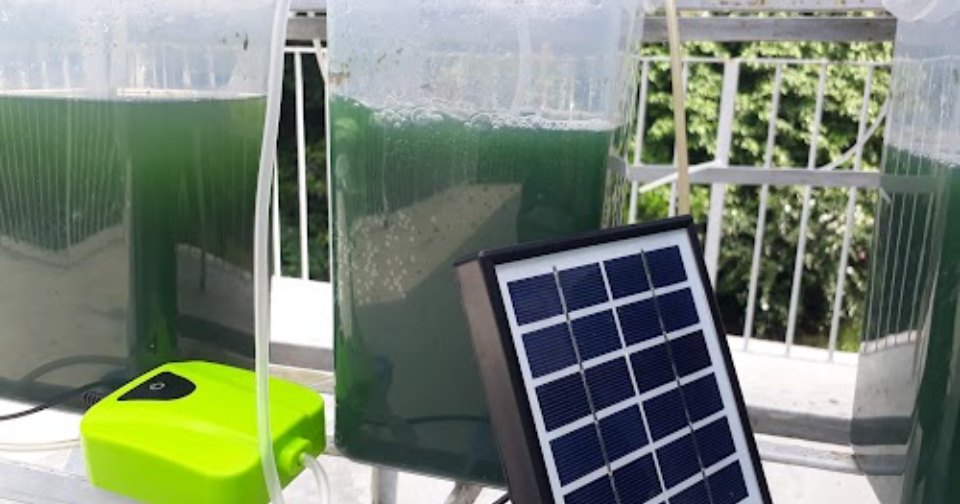
In open tropical raceway ponds, maintaining a pure monoculture of Spirulina during the monsoon season is challenging due to rainwater dilution, dust, and contamination by competing green microalgae (such as Chlorella) or protozoa. To solve this, we designed transparent vertical cylindrical photobioreactors powered by dedicated solar photovoltaic panels driving continuous oil-free diaphragm air pumps.
2. Zarrouk’s Alkaline Medium & Harvesting Protocol
Spirulina thrives in a highly selective alkaline carbonate-bicarbonate medium (pH 9.2 – 10.8), which naturally inhibits most contaminating microorganisms. Key operational parameters established in our trials include:
- Alkalinity Buffer: Sodium Bicarbonate (NaHCO₃) at 16.8 g/L paired with Sodium Nitrate (NaNO₃, 2.5 g/L), Dipotassium Phosphate (K₂HPO₄, 0.5 g/L), Magnesium Sulfate, and Ferrous Sulfate chelated with EDTA.
- Temperature & Illumination: Optimal biomass doubling occurs between 30°C and 35°C under 2,500–4,000 lux photoperiods with continuous air-lift agitation to prevent self-shading and photobleaching.
- Harvesting & Dewatering: Filtration through 300–400 mesh nylon bolting cloth at optical density (OD₅₆₀) > 0.8, followed by neutral water rinsing and low-temperature (< 45°C) dehumidified drying to preserve heat-sensitive phycocyanin.